Sunday, March 24, 2019

Coding = World Languages, an ongoing dibate

While the Industry tells us that they need well-rounded people, our educational system is still wearing blinders targeting "STEM" and ignoring the value of the Humanities.

The most clamorous example coming to my mind is the movement for recognizing CODING as a foreign language. While learning a second or third language develops skills and thinking patterns that facilitate the acquisition of a coding language, it so absolutely not true the reverse process.

These are some great articles arguing this case:

Tech Needs Humanities

"Encourage  them to be whatever they want to be!" I love and share this stand of Eric Berridge for so many reasons.
This is my mantra with my own students, in spite of what society and mainstream media are force-feeding to them, as Mr. Berridge very well presented.
While all my formal education has been mostly related to Humanities, in my personal and professional life I have always been attracted to technology. Hired as an international marketing specialist in the e-commerce business, I ended up working as a graphic designer and webmaster. This compilation of skills and knowledge turned out to be fundamental in the successful outcome of my first job in education, as Sped Aide, working 1-to-1 with an intensive need student.
Today I am a foreign language online teacher and Humanities are my worlds, yet technology is constantly present. Personally, I find hurtful recognizing their importance, while seeing how they are being shuffled to a class B or C level for the promotion of STEM. In my opinion, Humanities give students the opportunity to develop thinking abilities that, later on, can easily be transferred and applied to other domains. Mr. Berridge presents a very clear manner how the job force of today and tomorrow needs these skills and why we as society and in particular our education system, should support and promote students' interest in pursuing educational pathways in the Humanities, and not only in STEM.
This is a breath of fresh air, in my opinion, and I am very pleased of coming upon this video at this time. In the past 3 years I have been the Teacher Leader of the students' organization Educators Rising in my district., and I am looking forward to sharing this video with the sutdents of my organization for promoting some interesting discussions and hear their stands on this matter.


Monday, September 18, 2017

Back to school, one again...

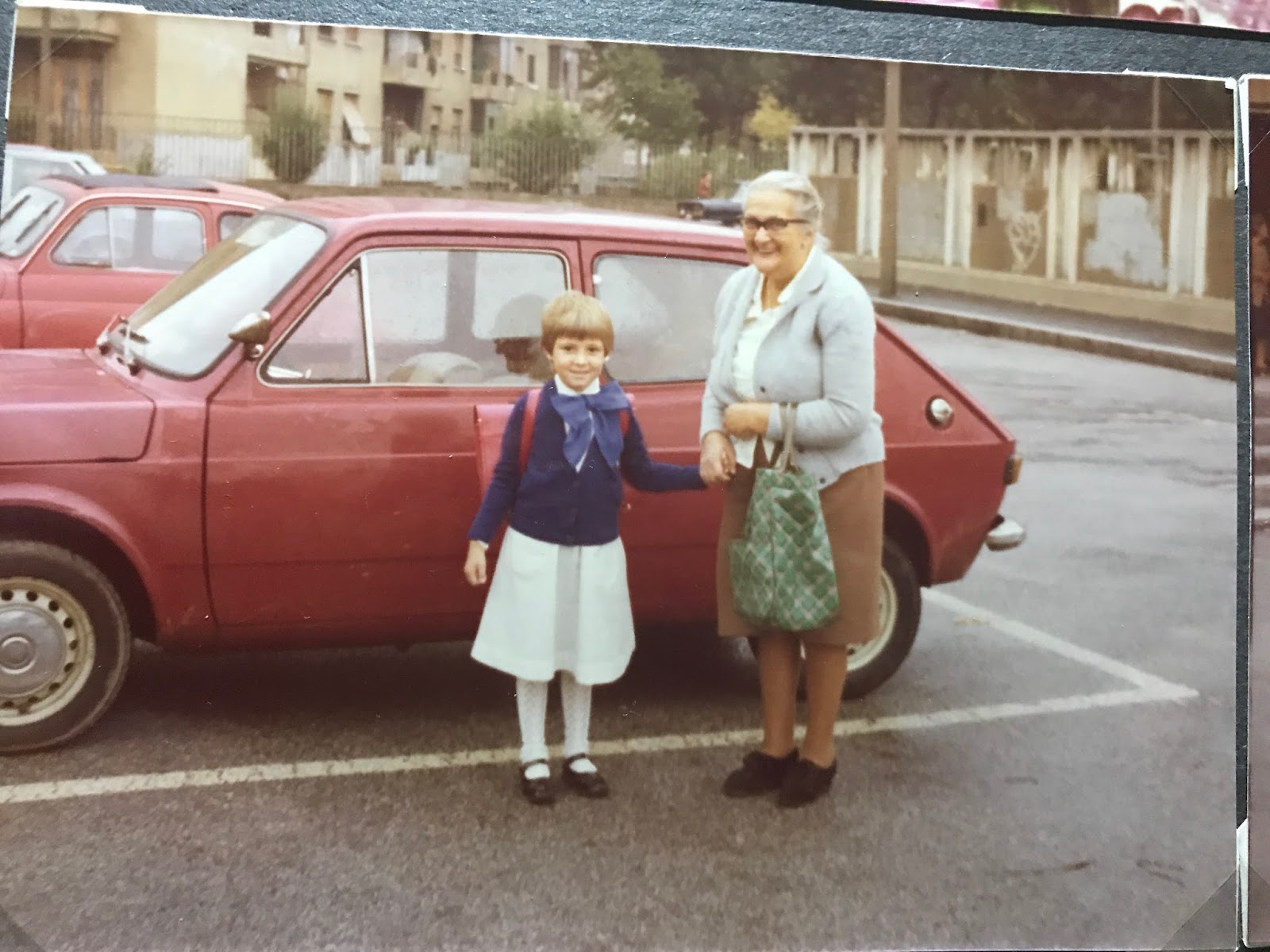
Me and my Grandma, on my first day of elementary school.
Looking at my Tweeter profile, I define myself as a lifelong learner, so no surprise that once in a while I am back again "taking my seat" in a classroom. It was a few years that I was pondering the option to enroll in the M.Ed. Learning Design and Technology, and finally this year I found myself in the "perfect storm" for dusting off my red messenger bag, ironing and starching my blue ribbon, polishing my black shoes, and head out to my "latest" first day in a classroom. Well, this time I did not have the tactic haircut I had back in this picture, indeed I learned not to play with gum with my brother... but this is an all different story, good for another occasion.

Honestly, I find it refreshing being a student. First I know all too well how much I need to learn about being an online Language teacher, and I am pleased to have the opportunity to have some formal training specifically on what I have been doing for the last 9 years on a "swing it" mode :)
Second, being back to the desk, helps me relate more empathically to my own online students. I have to admit, I am one of those people who FREAKS OUT for tests! Oh yeah... the sweaty hands, the grumbling stomach, lost of appetite but for chocolate, the sense of the incoming end of the world...well, that's me still today every time I have to take any sort of test. This self-awareness allows me to relate to my kiddos and try to do my best for making them feel comfortable and safe at the time of assessment so that we can really assess their mastery level and not their panic level.

Overall this new beginning is already great and I am excited to join a group of current educators in pursuing this common goal.

Now for the sake of sharing something true and false about me, here we go:
I have been teaching online foreign language for 9 years in Kenai. I used to live in Haines, and I miss very much the Southeast rainforest and PEOPLE! I do not know why, but people are just more friendly down there. In my free time, I love to do many activities such as making pottery, sewing, crocheting, kayaking, boating, fishing, skiing, reading a good book or two, and walking my dog and my cats in the woods. English is not my first language and I learned at school when I was a child. Although I love to have friends over for dinner parties, my husband has to do the cooking because I am quite challenged in that department...  :)

Saturday, October 15, 2016

Friday, July 29, 2016

Arduino Coding with AT Tiny

We are almost at the beginning of a new school year and it is time to get going planning what I want do with my students, which new and exciting  learning experiences I want to offer them, and how I am going to share with them the latest knowledge I have acquired during this summer at the Kodiak Virtual Learning Conference.
I have 2 plans I want to implement this year:
  1. Integrate paper circuitry activity in my Italian language online course.
I have decided to use my Italian 2 course for this integration because it is my smallest class and it will allow me to test this plan in a easy to handle environment. The Italian courses I am offering this year are not using any pr-canned curricula, but I have developed  on my own using some principles of TPRS (Teaching Proficiency through Reading and Storytelling) and other second language acquisition strategies. One element of my courses will be weekly creative writing, in which students will be asked to write reflections in the target language building up writing skills that will enable them to create short stories.  I want to use these short stories to be the environment for introducing paper circuitry. Depending on the response of the students I will see how far we can go with the complexity of the circuits and possibly to the coding.  
For these storytelling with paper circuitry I want them to use a blog for sharing their work and give them the opportunity to have an exposure and interact among them commenting and providing critical feedback.
The idea is to integrate Italian scientific vocabulary in the course and build up from there the use of tools that correspond to the language learned. The integration of paper circuitry will also allow the creative expression enhancing student creative writing and storytelling.
My plan is to have students create a monthly story with paper circuitry.
  1. Develop an high school level 1 semester course on Paper Circuitry & Arduino coding.
This is an idea that I have been discussing with Jeannine Huffman, David Cole, Nicole Fuerst, and Dr. Lee Grahm. The plan  is to be bale to create a course for introducing students to coding in a fun and playful way. It would be great if we could create a CTE course with dual credit, high school and college credit as well. This idea does not have a specific planning yet since it involves several people, however  I am looking forward to collaborating with all of these amazing individuals.
I would like to use this coming year for defining this course so that we could offer it to students next school year.
I believe that this course will be a valuable resource for our students for approaching coding in a fun way. At this time my school district does not offer any coding courses, however they recognize the important of this need for our students. My goal is to offer this course statewide so that all our students will have equal opportunity to accessing this resource and develop important skills for becoming 21st century global citizens.

Saturday, July 16, 2016

AKTeach Virtual Learning Conference 2016

This was my second year attending the AKTeach Virtual Learning Conference, and I have to admit that I am just so amazed and jazzed by the quality of the learning opportunities offered during the 3 days of this event. I would like to thank the AKTeach team, specially Phil Johnson and Nicole Fuerst for their work in putting together this small, yet powerful event, offering fellow Alaskan educators the opportunity for connecting and learning, in a very stimulating and interacting environment.
This year  presenters were amazing educators who worked with the attendees for 3 consecutive days sharing their expertise and helping us growing in skills and creativity, important aspects to bring back to our classrooms next month when we will start a new school year.

The session  have chosen this year was on Advanced Paper Circuitry presented by Jeannine Huffman and David Cole. The reason why I wanted to attend to this session was that I wanted to learn more about Arduino coding for using ATTiny processor with the paper circuity. Jeannine was awesome in guiding us though the process of the creation of paper circuits that could support t he movement mechanism managed by the ATTiny processor.
I loved the freedom of creativity we had during the workshop and how some of us took off in different directions more relevant to the domain of their work. We all were very engaged although we all were focused on different goals. This process made me think about how we teachers often expect our students to work on the same task at the same pace, while we should give them the freedom to make a task/project relevant to their own reality. I love being in the shoes of a student because helps me keep in mind their prospective when it comes down to my classes.

Something I really liked about this session was learning about how to create advanced paper circuits with movements regulated by a coded microprocessor on a budget! These days we all have to deal with cut to education and is very challenging to find the money for supporting cool and innovative educational experiences. For this reason I think that it is particularly relevant to find way to bring innovative and engaging STEM experiences to our students with a minimum cost!!!
 I personally feel so excited about what I have learned and I can't wait to share it with my students and my colleagues!

My take from this conference is that there is so much we can do with students and it is very important to network with other educators across the state and the nation for supporting, helping, motivating and sharing with each other the resources, great ideas, success and failure stories that can help all of us in being better educator and support and motivate our students.

If you have never been to the AKTeach Virtual Learning Conference I would strongly recommend to mark it on your calendar for next year. It s not a "major production" conference, however it is very rich and very powerful!

From Ideas to Planning... Reality Check!

I get very excited with new ideas and I start thinking of the many way I can share hat I am learning with my students, however there is a point that I find always very difficult, however very important and needed... the reality check of making a plan!

There are 2 different ideas that I would like to implement, the first is a short term plan, while the second is a longer term plan.

1. Integrating paper circuitry as a creative element in a world language course.
When is time for planning the implementation I like to start small, working with a small number of students, which helps in managing and reviewing the plan as it evolves. My smallest class next year will be a second year of Italian.
With this class I am planning to have students work on a notebook for a weekly creative writing in the target language.
Once a month they should create a short story in the target language and this story should be illustrated and over-layered with Paper Circuitry. During the first semester I would use Paper Circuitry without any addition of coding. During the second semester I would like to introduce the coding and offer them the option of a final project with creative writing/speaking illustrated by the graphic and Paper Circuitry with or without animation (with Arduino coding).
I want to leave this as an option because I want students to enjoy this activity and not seeing it as an imposition and despise it.

The World Language AK standards are so general that I could find a few standards I could tie to this activity. However what I am looking more closely are the ISTE standards that I think are very important for 21st century students.
1- Creativity and Innovation
4- Critical thinking, problem solving, and decision making.


2. Create a CTE Paper Circuitry/Arduino coding course for high school students.
This course could be delivered either online, or in a traditional classroom, or using a blended format.
In my school district at this time there are not coding courses offered to students and our district office is looking into adding this type of courses. There is the need for it and this is a good thing! :)
I have discussed this idea with Jeannine Huffman, David Cole, Nicole Fuerst, and Dr. Lee Grahm, and I am looking forward to collaborating with all of these amazing individuals for creating this course.

I am really excited about the second idea because this is what would finally get the attention of my school district to the Paper Circuitry activities and all the potentials they have to offer.

Saturday, July 2, 2016

What a creative mind!

In California, a community college professor creates a class for day laborers in a Home Depot parking lot.

Money, Money, Money.... Teaching and "Making" with or without them


My brother and I grew up playing with Lego all the time since it was made by simple solid plastic blocks. I remember the excitement when we had the first hollow pieces that were allowing to create some sort of articulation. Back then we did not even fathom the possibility of robotic Lego able to be complete action based on kids generated code...what a fantasy!
My brother at 10 poses proud next to the
robot he build using simple Lego blocks.
25 years later he published this picture in
the first page of his robotic engineering
P.h.D. thesis.
Interesting enough from playing with Lego my brother kept moving in this direction becoming a biomedical robotic engineer, while I have taken a very different route focusing on humanistic studies leaving Lego and constructions behind. In the recent years I was fascinated by the level of technology Lego has developed and I giggle to the idea of "playing with Lego" as I knew it because my nephews will have quite a different experience from what my brother and I had.

In schools across the country and worldwide robotic courses are offered to all grade levels, using programmable Lego robotics. What an amazing tool for learning in a playful and engaging way, isn't it?! The only down side is the cost that this material has. Yes educators can hunt for grants, when available, or engage in creative and extended fund raisers using tools such as DonorChoose.org or GoFundMe.com still not always these money show up and in those cases there is just a lot of disappointment and great creative ideas are put back in storage for that "one day" in the future... What a sad alternative, isn't it?


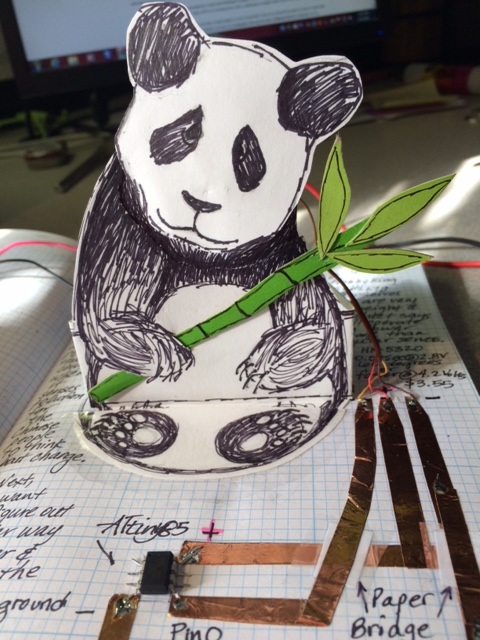
This summer I had fortune to participate to a 3 workshop on advanced paper circuitry offered by Jeannine Huffman and David Cole organized by AKTeach, Kodiak Island Borough School District. This workshop was following up a year of training with paper circuitry building up to this advanced level requiring coding and soldering a microchip to a paper circuit for activating an hand made (cut and colored) paper robot.... yes a PAPER ROBOT!!!
Jeannine Huffman's paper robot.
As you can see from this image of  Jeannine's Panda bear, you do not need even a fancy laminated paper-stock, but you can already create a simple robot drawing on white paper  and cutting out the image created. Yes you need some pieces of technology for the movement but definitely the difference in cost between this time of robotic creation and the Lego creation is quite remarkable... wile the creative experience and the coding experience is not that different!
Now the point I am trying to make is not that expensive technology is bad and cheep technology is good, but that you do not need to have a lot of money for offering students a creative, engaging, and technology rich learning experience! My personal approach is plan for no money and celebrate for whatever you can get!

In Alaska these days school districts are quite tight in finances, so this option of using simple and very low cost material is very appealing to teachers and administrations. I am personally planning to try to use a combination of fund raisers web tools such as DonorChoose.org and GoFundMe.com for purchasing the low cost material, so that I could use these money for offering this type of learning experience to a much larger number of students.

Friday, July 1, 2016

Social Media and Makers Movement in Classrooms


We are in the second haft of the second decade of the 21st century and Social Media are still a frightening reality in many classrooms, we can't deny this, however often the reason for this fear can is that educators of all levels, from teachers to superintendents, do not really know what to do with them and how to handle these tools in a safe environment for their students.

I have taught in schools in which many classroom doors post clearly "Cell free zone", "No Electronics Allowed", and so forth. In my classroom I have always had a big sign "Bring Your Own (Electronic) Device", and next to it a guidance of rules for the use of them. In my opinion it is important to encourage students in embracing technology in a mature and responsible way. A smartphone is such a powerful tool and has great potentials when used in the correct way in a classroom... this is why it is important to teach our students this very valuable skill.

Smartphones are the most common and efficient tools for using Social Media, and let's be honest at least 95% of our students have them in their hand for most of their waking time of the day. In spite of this, our students rarely realize that they could use these tools for "learning"!!! Did you have had students asking you some bizarre question? Absolutely, right! Now how many times you have replied "Google it and share with everyone what you find."?  It is amazing how kids often do not think right away of the potentials of this small device they "pet" all day long.

I really like the idea of Social Constructivism proposed by Dr. Richard J. Light of Harvard School of Education, stating that learning happens more effectively when there learners interact with other learners. a couple of years ago I read a few scholar articles presenting studies made in both secondary and post-secondary level education institutions analyzing differences in learning outcome of students who did and didn't use of social media in their classroom environment. The results were consistently in favor of the use of Social Media.


Let's now consider the great motivation boost that Social Media can offer to students when they can share with others their ideas and the what they create... what a powerful experience! Think of the opportunities they could access to if they were given the opportunity and the guidance for using for instance Twitter for connecting directly to they favorite authors, scientist, doctors, artists, engineers, asking questions and sharing their ideas and products... the potentials are really unlimited!

Educators have always to deal with budgets way too small for their dreams, however sometimes Social Media can be a way to reach out far and high at a low or no cost and at the same time it can offer the opportunity for marketing good ideas and products, creating a potential revenue that could support further "exploration".  This is a process that dos not happen overnight, but I believe that it is very important to initiate and promote for the good of our students, if we really what them to be successful 21st century global citizens!


Tuesday, June 14, 2016

How Writing by Hand Benefits the Brain

I have always believed in the importance of hand writing and although I am an online teacher, I always require my students to do some of the language writing work by hand instead of on the computer.
Over the years I came upon students and parents who disagreed with this requirement for an online course and they challenged this type of assignments. I have always replied that the use of handwriting is very important for supporting and promoting a well rounded acquisition of a new language code since it stimulates the brain in a unique way.
I am glad that now I have some more evidence for supporting my stand on this specific matter.

The Lowdown on Longhand: How Writing by Hand Benefits the Brain: Studies show that note-taking with pen or pencil is critical to processing and representing information, something that students lose when tapping on a keyboard.

Recording History With Students - Tools & Ideas

Recording History With Students - Tools & Ideas

Thursday, February 25, 2016

Why Educators Need to Promote Themselves

Why Educators Need to Promote Themselves: Educators often have trouble acknowledging their contributions to good outcomes. Here are some tips for changing that.

Monday, February 22, 2016

Drop the Textbooks and Blend Language Learning

The 2016 is going to be a very exciting year form the Language Department of the Kenai Peninsula School District (KPBSD). Indeed we are going to see a drastic change in how students learn all the World Language classrooms since all World Languages teachers will have to implement a blended format. KPBSD has indeed recently completed the curriculum review for the World Languages courses offered within the district, and the committee has opted with an unanimous and strong decision in favor of adopting a digital curricula for ALL the language courses offered in the district. This decision is aligned with the vision of the district administration to move toward digital content for the classrooms.

The revision process has been rigorous, evaluating traditional and web-based curricula side by side following a rubric based on the standards defined by the American Council of Teachers of Foreign Languages (ACTFL), the national leader organization in the teaching of world languages.
This was the first time I was participating in the curriculum review process and the experience has been very interesting and instructive. Being an online teacher, the only online foreign language teacher in the district, I was pleased in having the opportunity to bring to the table my different prospective, and collaborate with other WL teachers in finding the best fit for our students.

The adoption of an online based curriculum requires some structural changes in the traditional classrooms and how the learning is going to happen, and some of them were welcomed by some teachers. First of all WL classrooms will receive a class set of Chrome-books for allow students to access to the online content. Second the teachers will have to implement a Blended Learning format for their classroom. This specific step does require a specific, timed, well planned and delivered professional development (PD) for the classroom teachers, who will need to learn what Blended Learning is, what are the various ways in which it can be implemented, and finally being able to identify the format that would better fit their teaching style, their classroom needs, and what they want to achieve.

It is definitely an ambitious goal that will require time for being perfected, and I am expecting trials and errors along the way, which is normal in a learning process. Last year I had the opportunity to experiment a similar learning progress when I had to start a traditional classroom French program in one of the KPBSD high schools. Coming from a 100% online teaching experience, I found a natural fit in the use of the Flipped Classroom approach from my classroom courses. One of the most interesting observations in the roll-out of this plan was looking at the switch in the student behavior  from the beginning of the year when they were very passive and they needed to "hold their hand", to the point in which for the most part they knew what to do and were able to proceed independently in their learning in and outside of the classroom.

The transformation of a traditional classroom to a blended format requires a very well made plan and also a lot patience and determination from the teacher, especially at the beginning, when the students  used to be mostly passive learners in their classrooms, will find themselves pushed in uncomfortable  new learning territories, in which they are required to become actively participants in their education.

I have an invested interest in following the process of implementation of the Blended Learning in my WL department, since I would like to collect data for a research paper focused on this case study. My goal is to monitor the effectiveness (positive or negative) of this switch in the increase language acquisition in the students enrolled in these blended courses.

More will come....

Saturday, December 12, 2015

Fail to plan is plan to fail!

Mr. Franklin was very right, a good plan is very important for a successful outcome. This is absolutely right when we are talking about the creation of videos for an online course.
In the past I have done my share of video on the moment, with outcomes that sometimes were very disastrous, taking so much time for cleaning up the videos from pauses, stumbling thoughts, and so forth.

Planning a good video is a task that requires time and effort for doing it right.
Various elements that needs to be considered in the planning process are
  • Time-frame - Best practices recommend to stay within the 3 minutes but depending on what you are trying to present, sometime you need more time. No matter what, try not to go over 7 minutes.
  • Consider what you want to present to your audience: what are the sections of the course you want to show or highlight? Why?
  • Focus on the anchors of the course, the important elements that every student should be familiar with right from the start.
  • WRITE it DOWN! Yes, it is important to do it! Yes, often we THINK we know what we are going to say, but the truth is that when we start recording ourselves we can so easily get sidetracked and loose the target we had in mind the at the beginning. The result usually is a very unpleasant and not very functional waste of time!
    Write down what you want to present in a script. Educational Use of Digital Storytelling  is a great site for finding resources for this process, including templates for the storyboard of your video. I like the simplicity of the second version of the Word template found in the middle of the article.
  • Evaluate which tools you ave available for recording your work, compare pros and cons depending on the situation. Sometime you need to make a podcast on the fly, so you are willing to sacrifice on quality of image or sound, while if you have the time and the access to a good video/screen recording tool, is worth to spend the extra time for doing a good final product.
    Personally I like to use Camtasia Studio for creating my videos. It requires some editing, but it has great potentials!
Here below you can see an example of SCRIPT I have done for an introductory video for my new courses, and the final product of the video.
SCRIPT - Introduction to Mrs. Pokryfki's courses


.
CHALLENGES
Sure, every project has to have a good share of challenges to deal with. In my case, for this specific video I came upon a good variety.
1. Do not give for granted that the content of your course will be the same next year ... with the Foreign Language department curriculum review will come new material - I am very excited about this, but I will discuss it in another post - therefore the video I have created right now might not be accurate next year.
2. Do not give for granted that the LMS interface will be the same next month!Just last Friday I was informed that in January we will be moving to the new interface which means that all the videos we have made new last August will be to be redone!
3. Plan in advance a general script and be ready to adjust it at the last minute since you do not always have access to the new interface long before students roll in your courses.

These are some of the challenges you might encounter, but I am sure that there can be more to add to the list.... Bottom line, be ready like a Kong-Fu Panda for attacking the content and create your videos :)

Saturday, November 21, 2015

The Cloud for Collaboration

One of the most relevant tools for increasing engagement in online courses has been proved to be the interpersonal connection, which is strongly supported with the use of collaboration as format for formative assessments and practices.
Based on the feedback I have received from my online students over the years, they always loved the opportunity to feel being part of a class and sharing ideas and experiences with their peers.
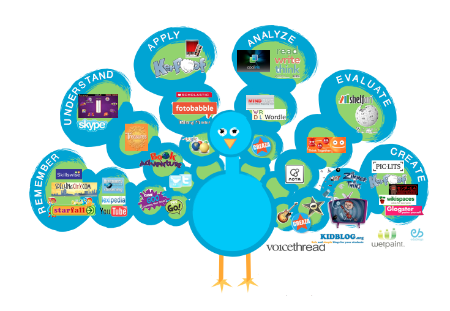
https://cynthiabaertichblog.files.wordpress.com/
2014/07/100-best-web-2-0-classroom-tools.png
Usually LMSs offer opportunity for fostering collaboration among students. For Moodle users some build-in tools for collaborations are the forums, great for class discussions, the glossaries, good tools Poodles offer the opportunity for collaboration using voice or video recordings - however, based on my experience, they can be giving some technical challenges sometimes.
for collaborative activities on specific topics;
With Canvas the build-in collaborative tool is the discussion. A very nice feature of this tool is the option of assigning peers review of the post either manually or randomly, which means that each student is given the name(s) of the person(s) they need to interact with. This helps in pushing students toward reading and commenting on posts of people they do not know and that they might not have chosen on their own.

My favorite collaborative tool that I have been using for several years is VoiceThread. The best way  I can explain what this tool does, is defining it as PowerPoint on steroids! You can use still images or videos individually or in a slide show, and students can comment on each frame typing or recording their voice or video. Everyone can listen to other people's posts and they can build in or comment. I have used this tool in various ways: mostly I used for recreating the classroom interaction with my students in the target language. What I like so much about this tool is that is so versatile and I can use it for my interactions with students as class while each of them can listen to what other students are saying. For foreign languages online courses this is a great asset!

Other tools that I have been using include Google Doc/Google Drive for , Blackboard Collaborate, and Microsoft Lync.

Researching on the Internet for resources I have found several websites providing a lot of good resources. Those that I would like to recommend are Kathy Schrocks - Guide to Everything
and EmergingTechEd. These sites present a very good variety of tools for promoting collaboration.
One tool that I have found on these sites that I have not yet yet but that I find intriguing to try is
Bubbl.us.

I am not quite sure how to implement this tool to my courses, but I think that it would be a good tool for reviewing language structures in peer groups. I will play with it and I will add more ideas for using Bubbl.us in another post.

Monday, November 16, 2015

Essentials For Engagement

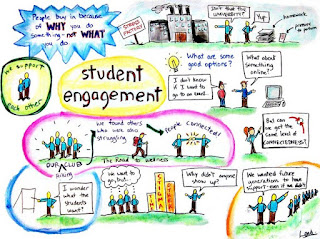
I just got back from a week of super-intersting-exciting-total-immersion in the iNACOL symposium. This was my very first time at this conference and I am completely blown away by this experience. The Keynote Speakers were all remarkable and the educators presents were powerful. For the first time EVER I was able to find 3 other "white flies" like myself teaching foreign languages online in an asynch environment... one is from Oregon, one is from Wisconsin, and the last one is from Minnesota. We bonded right away and collaboration flew right on... but this is the topic for another 
http://ow.ly/UK0NH
post! :)
Let's get back to iNACOL.... "Competency-based Education" was the buzz word this year, and a good number of sessions focused on strategies for switching to this type of education where students are not seeking a grade but learning!.. what an odd concept, isn't it? - chuckle -  I deeply agree with these principles and this is what I envision for my ideal online courses. This is my most ambitious goal and I am not sure how long it will take to achieve it, but I strongly believe that this is the greatest investment I can do for my students.

When I look at my courses critically, I have to admit that students are working for the grade, which somehow I find sad, however I can identify myself in this kind of rat-race for the A whenever I am enrolled in a college class. Unfortunately our educational system is focused on grades and GPA is an extremely important element of every students' life from high school level on. Grades define who you are, how good you are, which prizes or scholarships you might earn,  which college might accept you, and so forth. But what about what students really KNOW and MASTER?
In my opinion the overall "design" of education should reflect encourage and promote mastery and competency and be the framework upon which creating individual pieces of education, such as our courses.

Why am I going off on Competency-Based Education when I am trying to talk about students' engagement in online courses? Well, in my opinion the actual educational framework of a course creates the premises for the effectiveness of all the bells and whistles needed for promoting and supporting students engagement.

I have been reading several articles about students' engagement in online courses - I found a great collection of resources on Edutopia  and there is a lot of scholar articles on this topic as well - and I see that all strategies have in common one aspect: the importance of the human connection!
In spite of the technology in which online students and teachers are plunged in, the element that really connects educators and students and hooks students is the human connection established with the instructor and among peers.

John McCarthy, author of "Igniting Student Engagement: A Roadmap for Learning"  places "being real" as first practice. He meant to focus on the the authenticity of the learning process, however this step requires the knowledge of students for being able to create a connection between the authentic component and their personal lives and interests.
Ali Briggs in "Ten Ways to Overcome Barriers to Student Engagement Online"provides a very nice outline of steps to follow for establishing a positive environment that would support and promote student' engagement in online courses.
I went through the checklist and I did a self reflection... I did not need to go too far for finding my "guilty" spots. It is so hard sometimes to organize your days for fitting everything, but I like having this checklist now as reference for what I need to prioritize, considering that the consequences could be failing my students and loosing the priceless connection with them.

Going back to the connection between competency-based learning and engagement, I think that it is pretty straight forward recognizing how a student would feel more connected with the content studied in a course when he/she has the feel for it and can see and measure her/his own progress in a realistic manner, not framed by grades. 

I am going to make a checklist sheet with these important steps and I will post it here in the blog for whoever wants to use it.