Showing posts with label Paper Circuitry. Show all posts

Saturday, July 16, 2016

AKTeach Virtual Learning Conference 2016

This was my second year attending the AKTeach Virtual Learning Conference, and I have to admit that I am just so amazed and jazzed by the quality of the learning opportunities offered during the 3 days of this event. I would like to thank the AKTeach team, specially Phil Johnson and Nicole Fuerst for their work in putting together this small, yet powerful event, offering fellow Alaskan educators the opportunity for connecting and learning, in a very stimulating and interacting environment.
This year  presenters were amazing educators who worked with the attendees for 3 consecutive days sharing their expertise and helping us growing in skills and creativity, important aspects to bring back to our classrooms next month when we will start a new school year.

The session  have chosen this year was on Advanced Paper Circuitry presented by Jeannine Huffman and David Cole. The reason why I wanted to attend to this session was that I wanted to learn more about Arduino coding for using ATTiny processor with the paper circuity. Jeannine was awesome in guiding us though the process of the creation of paper circuits that could support t he movement mechanism managed by the ATTiny processor.
I loved the freedom of creativity we had during the workshop and how some of us took off in different directions more relevant to the domain of their work. We all were very engaged although we all were focused on different goals. This process made me think about how we teachers often expect our students to work on the same task at the same pace, while we should give them the freedom to make a task/project relevant to their own reality. I love being in the shoes of a student because helps me keep in mind their prospective when it comes down to my classes.

Something I really liked about this session was learning about how to create advanced paper circuits with movements regulated by a coded microprocessor on a budget! These days we all have to deal with cut to education and is very challenging to find the money for supporting cool and innovative educational experiences. For this reason I think that it is particularly relevant to find way to bring innovative and engaging STEM experiences to our students with a minimum cost!!!
 I personally feel so excited about what I have learned and I can't wait to share it with my students and my colleagues!

My take from this conference is that there is so much we can do with students and it is very important to network with other educators across the state and the nation for supporting, helping, motivating and sharing with each other the resources, great ideas, success and failure stories that can help all of us in being better educator and support and motivate our students.

If you have never been to the AKTeach Virtual Learning Conference I would strongly recommend to mark it on your calendar for next year. It s not a "major production" conference, however it is very rich and very powerful!

Saturday, July 2, 2016

Money, Money, Money.... Teaching and "Making" with or without them


My brother and I grew up playing with Lego all the time since it was made by simple solid plastic blocks. I remember the excitement when we had the first hollow pieces that were allowing to create some sort of articulation. Back then we did not even fathom the possibility of robotic Lego able to be complete action based on kids generated code...what a fantasy!
My brother at 10 poses proud next to the
robot he build using simple Lego blocks.
25 years later he published this picture in
the first page of his robotic engineering
P.h.D. thesis.
Interesting enough from playing with Lego my brother kept moving in this direction becoming a biomedical robotic engineer, while I have taken a very different route focusing on humanistic studies leaving Lego and constructions behind. In the recent years I was fascinated by the level of technology Lego has developed and I giggle to the idea of "playing with Lego" as I knew it because my nephews will have quite a different experience from what my brother and I had.

In schools across the country and worldwide robotic courses are offered to all grade levels, using programmable Lego robotics. What an amazing tool for learning in a playful and engaging way, isn't it?! The only down side is the cost that this material has. Yes educators can hunt for grants, when available, or engage in creative and extended fund raisers using tools such as DonorChoose.org or GoFundMe.com still not always these money show up and in those cases there is just a lot of disappointment and great creative ideas are put back in storage for that "one day" in the future... What a sad alternative, isn't it?


This summer I had fortune to participate to a 3 workshop on advanced paper circuitry offered by Jeannine Huffman and David Cole organized by AKTeach, Kodiak Island Borough School District. This workshop was following up a year of training with paper circuitry building up to this advanced level requiring coding and soldering a microchip to a paper circuit for activating an hand made (cut and colored) paper robot.... yes a PAPER ROBOT!!!
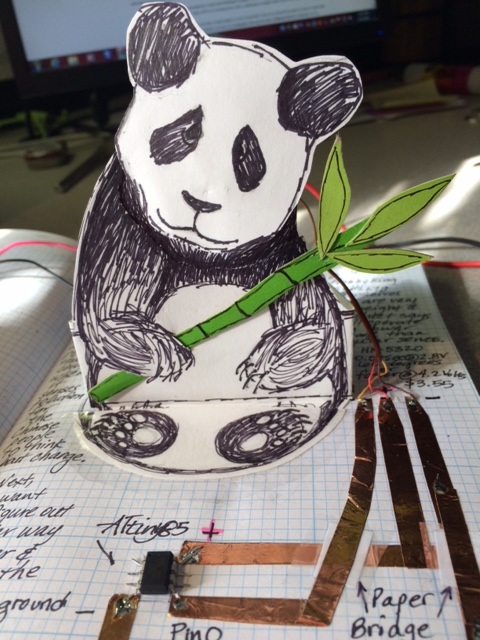
Jeannine Huffman's paper robot.
As you can see from this image of  Jeannine's Panda bear, you do not need even a fancy laminated paper-stock, but you can already create a simple robot drawing on white paper  and cutting out the image created. Yes you need some pieces of technology for the movement but definitely the difference in cost between this time of robotic creation and the Lego creation is quite remarkable... wile the creative experience and the coding experience is not that different!
Now the point I am trying to make is not that expensive technology is bad and cheep technology is good, but that you do not need to have a lot of money for offering students a creative, engaging, and technology rich learning experience! My personal approach is plan for no money and celebrate for whatever you can get!

In Alaska these days school districts are quite tight in finances, so this option of using simple and very low cost material is very appealing to teachers and administrations. I am personally planning to try to use a combination of fund raisers web tools such as DonorChoose.org and GoFundMe.com for purchasing the low cost material, so that I could use these money for offering this type of learning experience to a much larger number of students.

Monday, October 19, 2015

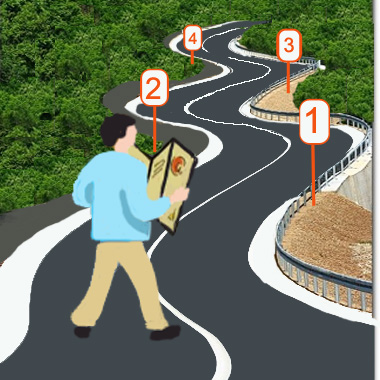
Everyone needs a road-map!


This is even more important when we are talking about online courses. Over the years teaching online I have found how important is to give students right at the very first contact an effective and user friendly tool that takes them exactly where they need to go in the course and that shows them around the course as a good hostess.

Thinking about it seems a pretty logical tah! idea, right? The challenge is making an EFFECTIVE introduction video!
This process takes quite some time, effort and definitely a few failures to launch. After working on Moodle for 5 yeas I thought I had my intro video pretty much nailed down to perfection. I was so proud of it. This year though with the adoption of the new (for me) LMS Canvas I had to remake all my introductory video on a LMS I was not very familiar with, so I am back dealing with my first "failure to launch" Canvas' road-map.

It is amazing how many things I learn in the first 48 hours of the school years, when the floodgate is open and students are pouring into the courses. That's when you find out a lot of the things that can go wrong! This time around though there was a particular step that I totally underestimated and that has proved to be critical in the misguidance of students arriving to the course. I had some great conversations with some of my colleagues at the Distance Learning department, and we are planning to put our hands back on the video and create some guidelines for all our intro to the course videos so that students enrolled in any of our courses would find some sort of consistency in the navigation.


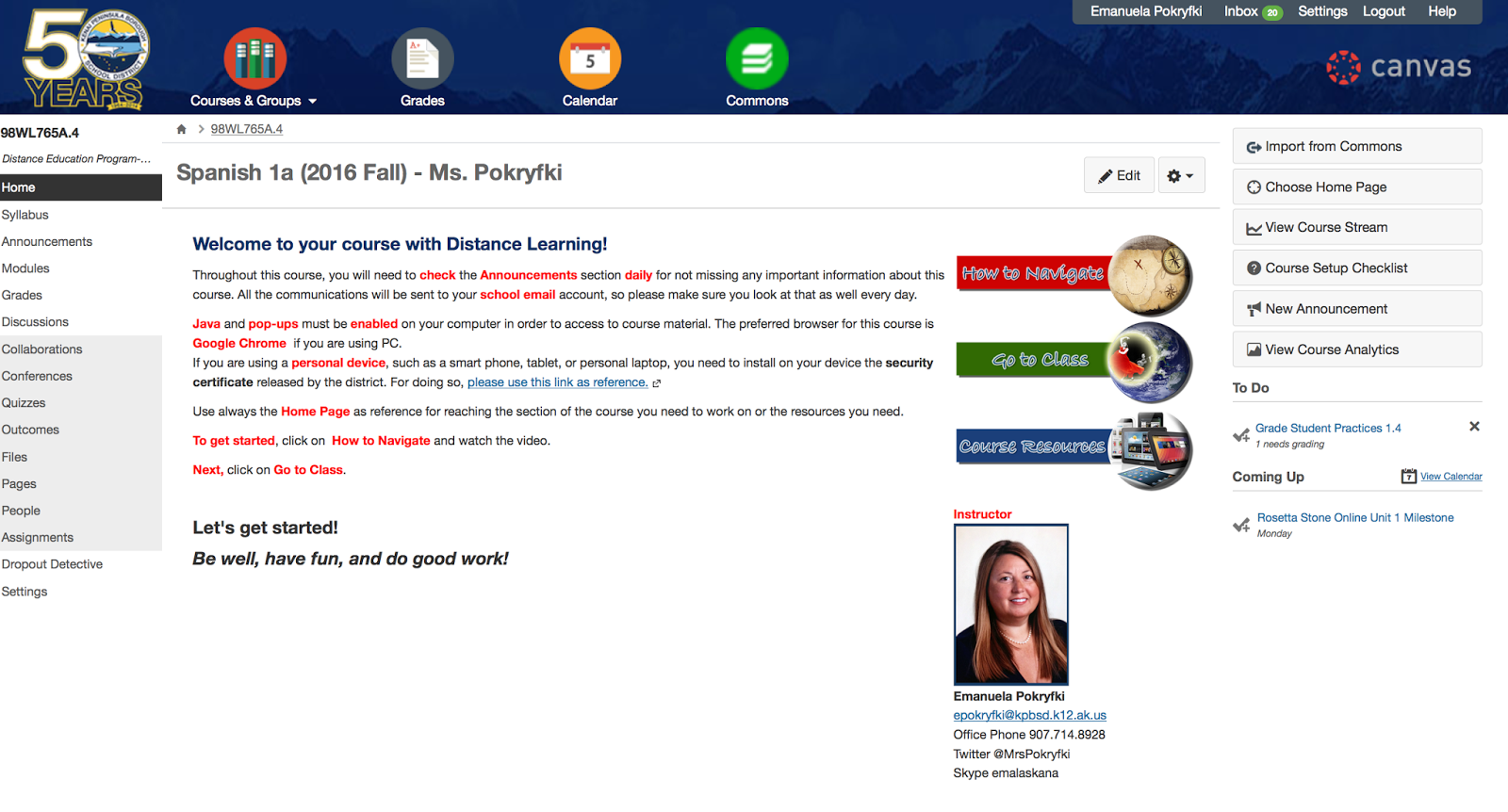
This is my first Canvas intro video and the Home Page shown here actually has been already restyled reducing the size of the 3 buttons, placing them on the right of the welcoming message, and adding my photo and contact info right under the buttons, as you can see in this image on the right.
I am not yet 100% satisfied with the layout of my home page, however this organization did not cause any troubles, while the video did, and this is why I would like to start tacking that first.

I would greatly appreciate any constructive criticism about the video and if you have 2 cents also for the home page, feel free to throw them here as well :)

Next step: listing problem caused by the current video and then start planning the new video!


Saturday, September 19, 2015

Paper Circuitry Resources


Printable Notebook http://mrspokryfki.blogspot.com/
This booklet was produced by CV2 and Nexmap and can be printed and used as learning tool following the Creative Commons conditions cited at the end of the notebook.

Jie Qi http://technolojie.com/category/featured-projects
She is the GURU of Paper Circuitry


Exploratorium http://tinkering.exploratorium.edu/paper-circuits San Francisco based research organization with tons f resources.

AKTeach http://www.akteach.com

You can purchase material such as the sticker LED lights from them. They also have tutorials and educational material. This is only for Alaska school Districts.

Cibitronics http://chibitronics.com/education/
You can purchase material such as the sticker LED lights from them. They also have tutorials and educational material.

NextMap https://nexmap.squarespace.com/hynbd-resources/

How to Videos on YouTube
Folding Copper Tape for Paper Circuitry
Soldering & Adding Microcontrollers to Paper Circuits

Educational resources and Professional development
Google+ communities:  AKTeach, 21st Century Notebooking, and Aste Networks.

My Examples of Paper Circuitry
iNACOL - Project Based Learning sesssion - Final product
Mrs. Pokryfki HS students and other learners of Paper Circuitry

Saturday, August 1, 2015

AKTeach Conference: Final Project / Plan of Implementation

What I am going to do with what I learned... 


My vision for the implementation of the acquired knowledge has 2 related yet different plans:
The first focuses on sharing the acquired knowledge with peers educators, while the second focuses on sharing this knowledge with my own students. 
  1. Plan 1. I believe in the importance of sharing acquired knowledge with fellow educators (teachers and administrators) for promoting and nurturing an environment of cross curricula project based learning in line with the makers movement.
    I am planning to share with fellow educators presenting a session the following events:
    • Professional Development workshop with  educators of my school district,  KPBSD - Kenai Peninsula Borough School District. I have already emailed my administrator and the PD coordinator presenting my intention of offering this workshop. I am waiting to hear back from them for planning the details of this events.
      I would like to offer this workshop to teachers of various subjects, especially I would like to involve the Art, Science, World Languages and Language Art teachers since this could promote some collaborative cross curricula projects for our students.
      The material I am planning to use in this workshop is a basic kit formed by: copper tape, copper wire, conductive paint, multimeter, led lights, and batteries.
      I am planning to ask the district for financial support in financing the kits, especially for the purchase of the multimeters. We will have to decide if this material will stay with the teachers or if will be used during the workshop and then returned for further use.
      I would like to use the templates created by Jie Qi for making a simple and handmade notebook for the participants with the patters to use for getting started and learning how to create a simple circuit, a parallel circuit, and a switch circuit.
      More complex circuits will be shown as model using videos, and explain the material needed for those creations.
    • Webinar for ASTE Creativity and Communication SIG. This webinar will be offered to ASTE members using Goggle Hangout. I would like to offer this webinar at the end of August or beginning of September. This is a max. 1 hour webinar in which I would like to offer an introduction to Paper Circuitry explaining what it is about, and showing the material used for realizing it and some of the examples I have created, and, if I can organize it some examples made by other participants of the Kodiak AKTeach Conference.
      The nature of the webinar does not allow hands-on practice, especially for the short time-frame of the session, however it will be a good start for getting people interested in learning more about Paper Circuitry.
      I will provide links to web resources for learning more about this technique.
    • AFLA (Alaskans For Language Acquisition) Conference, September 18-20, Anchorage. I will present a session at this conference in collaboration with Lindsey Glenn, Spanish teacher at the Kodiak Island School District.
      This session will be an hands-on workshop of 4 hours in which we will first introduce the concept of Paper Circuitry using some YouTube videos, such as the video of Jie Qi of the interactive painting of the dandelions, then using the material for getting familiar with this technique and challenge the participants in coming up with some creative solutions for a second language course project.
      The material I am planning to use in this workshop is a basic kit formed by: copper tape, copper wire, conductive paint, multimeter, led lights, and batteries.
      I am planning to try to find financial help (gofundme/donorschoice) for purchasing the kits. We will have to decide if the multimeters will be given to the participants or if will be used during the workshop and then returned for further use in other workshops fsince this items are the most expensive of the kit.
      I would like to use the templates created by Jie Qi for making a simple and handmade notebook for the participants with the patters to use for getting started and learning how to create a simple circuit, a parallel circuit, and a switch circuit.
      More complex circuits will be shown as model using videos, and explain the material needed for those creations.
    • ASTE Conference, February 2016, Anchorage.
      I am planning to collaborate with a team of other 4-5 teachers who participated to the Paper Circuitry strand at AKTeach Conference, so that we can provide a variety of experiences with application of this technique in various levels of educational environment both in traditional classroom and online.
      I am planning a full day workshop, using the strucutre used for the AFLA conference, but allowing more time for creative production. Depending on the financial support received, either with a grant or from ASTE itself, we could purchase some more tools for our kits.
      I would like to see if during this conference we could have as guest through video-conference Jie Qi, David Cole, and Natalie Freed.
  2. Plan 2. Implementing the use of paper circuitry projects in one of my foreign languages courses.
    I would like to pilot the application of this technique with a small groups of students, so I will use only one of my course and use it for one project.
    Working with a small group will allow me to troubleshoot my delivery methodology and the possible problems that could arise since I teach online and I will have to orchestrate the delivery of the material to various sites in my school district.
    I need to have the numbers of the enrollment in my courses for deciding which course use for this pilot.
    I would like to start with a simple project, such as image/word matching.
    I will probably have this project done around the month of October, when students are finally sledded in their school routine and  they can focus better on more complex activities.
    My hope is to engage some science teachers, so that students could do a cross curricula project.

In my opinion these 2 plans are connected and somehow sequential in a vision of sustainability since  promoting and supporting the makers culture in our school districts with our administrators and our fellow teachers of all disciplines is fundamental for being able to implement cross-curricula project based learning with our own students.
I will keep tracking the progress of these two plans in this blog, and I am looking forward to collaborating with exceptional educators in the presentation at the various conferences.


Friday, July 3, 2015

Paper Circuitry Presentations - Call for Collaborators!

I would like to put it out there: I am planning to present Paper Circuitry at AFLA and ASTE.

For the AFLA conference I was thinking about collaborating with SeƱora Glenn since we are both foreign language teachers.
For the ASTE conference I was thinking that it would be very powerful preparing a full day hands-on session with teachers of various subjects and different grade levels for showing cross-curricula hands-on project-based learning.
Lindsey, Ryia, Amanda, Andrea, Nicole, I was thinking of you for sure and whoever else would like to join in would be great!

The outline of the presentations at the 2 conferences will be part of my project of implementation, however I understand that it will be subject to further work in the next months depending who will be collaborating in this project.
I will be back to AK on the 19th of July and after that date I would love to "hang-out" for collaborating on these projects.
I am so excited about it, and I hope we could get a "dream-team" going! :)

AKTeach Conference - My Reflections


In this post there are my reflections about the Kodiak Virtual Learning Conference 2015 divided in the 3 steps provided by the guidelines of this task.


Step 1: Explain the difference in your knowledge and skills at the beginning of the conference and the end of the conference.

When I have received the first communication about the Virtual Learning Conference I was so taken by my own busy teacher's life that I did not have the chance to investigate in depth about the sessions offered by this conference. At first I was confused by not being allowed to attend to more than one strand during the two days of the conference. At that time I found this "rule" unusual and somehow unreasonable. There were at least  couple of sessions that I wanted to attend and having 2 days I assumed that I could have used one day for each session. It was just during the conference that I had an epiphany understanding the very good reasoning behind the "1 session rule", and I will explain it later.
I proceeded by elimination for deciding which session to attend, trying to focus on what I could benefit the most for my professional commitment in the next school year. Although I found Natalie Freed & David Cole strand intriguing (Integrating Paper Circuitry Into Your Classroom) I felt intimidated by the description of their session, especially the words "building circuits in notebooks all the way up to introducing how to code/program circuits". In my mind the "notebook" was synonymous of laptop, and although I am a "computer literate" user, I am quite "illiterate" when it comes down to the actual electronic component of technology.  Bottom line I considered this session "out of my league".
Moving to the next, Crystal Thomas was presenting Edgenuity & Blended Learning. My school district does not use Edgenuity, therefore I would have not benefit much from this session.
Sally Eberhart, Apple Trainer, was presenting a session that was catching my attention: "Getting The Most Out of Your Macbook". Although my school district is officially a PC district, Apple machines are crawling into the district. During the past year I had mini Ipads to use with my classroom students, and I used my personal Mac Notebook for editing and publishing my students IBook projects. Certainly this session could have been interesting!
Dr. Pam Loyd and John Monahan were presenting "how to build a UAV and explore how to integrate unmanned aerial vehicles into your virtual classroom". In spite of my curiosity for UAV, I could not see any practical benefit for my professional development, so I nixed this session as well.
The last session listed was "The America Bridge Project-Building Projects, Partners, & Connections" lead by Ron Fortunato. Honestly I had no idea of what this session was about, and reading the presentation of the session I did not feel any "sparks", thus I passed.

Based on my elimination process I ended up selecting the Macbook session at my time of enrollment to the conference. It was few days later that I had the opportunity to discuss my choice with Nicole Fuerst, sharing my feelings about the paper circuitry session. It was Nicole who reassured me that I did not need to be an electric engineer for participating to this session and that in her opinion I would have benefit the most from this very strand. I trusted her good judgment, and looking back I am so grateful for her guidance! Certainly if I had taken the time to snoop around the web about paper circuitry I would have understood Nicole's advice right away, instead of during the conference...

Anyway, going back to the actual topic of this first step, I had no clue of what I was about to do when I walked into that classroom last June 1st, and when I opened the plastic box given to each attendee, there were only 3 items I was familiar with: a pencil, a flat battery, and the scissors! :)
During David Cole and Natalie Freed opening session I started grasping some of the potentials of this technique of applying technology to crafting, creating so many versitile artifacts. Watching the video of Jie Qi interactive painging of the dendilions I felt like Alice in the Wonderland, when she fell in the rabbit's hole... so many potentials for creativity!!!


During the 2 days hands-on workshop I appreciated the rare and precious opportunity to explore more in depth a single session, having the time for practicing, creating, asking questions, making mistakes and sharing thoughts, ideas, and visions with other neofites as well as with some experts, such as David Cole, Natalie Freed, and Jie Qi who joined us via Skype from the MIT lab.

The conference did not make me an electric engineer (although I have to admit that I bragged with my husband of my playing time with electric circuits!) however it made me realize that I do not need that qualification for being able to use these circuits in very simple and creative ways with my students. Working side by side with teachers of various subjects and grade levels has been also a great experience providing a lot of ideas for creative cross curricula applications of the paper circuitry. It was so fun playing and trying to figure new ways to apply this process in various ways.

Step 2: Explain how this experience will change your teaching practice, your administrative work, or how you support and guide colleagues. 

I do not think that this experience will "change" radically my teaching practice, but it will enrich it for sure!
Talking with the other educators attending the session made me think of ways I could apply the paper circuitry technique for engaging my world languages students using more hands-on and project based approaches in my courses and branching out more to science and art field.

Mostly I feel very motivated and excited in sharing this experience and what I have learned with colleagues first in my district and later, beyond KPBSD with the goal of connecting more effectively world languages courses with Science and Art, hopefully collaborating with other teachers in creating some cross curricula projects.
I have already emailed to my admin and to our district office presenting my desire for sharing my experience with fellow educators in  one day PD session during next school year.
Also I am planning to collaborate with few other teachers from other districts (Kodiak, Ketchikan, and Juneau)  for presenting a session at first at the AFLA conference next September,  and later at ASTE next year on this very topic.

Step 3: Reflect on how you are a virtual teacher...even if you haven't previously viewed yourself that way. Why do you think it was appropriate for you to attend the conference?

I am a virtual teacher, no doubts!
I have been teaching online for 7 years now and beside last school year, I have never taught in a traditional classroom, but only via distance delivery.
Over the years I have developed various courses for French, Spanish and Italian, mostly in async mode since this is the preferential deliver offered by our district, however I have implemented more and more blended component over the years.
When I started teaching online there were not yet courses specific for online education offered in AK, so I had to learn on my own, with trial and error and direct experience. I was so leased to find out that now UAS has a program for a teaching endorsement specific for online teaching, and during the conference I had the fortune of sitting next to Dr. Grahan, who is the chair of this program. In the couple of days we were at the conference I had the chance to ask a lot of questions about the course and I am going to enroll in it next spring! I was so excited in finding out about it and the opportunity to receiving a more formally structured preparation for my type of teaching.

As for the conference itself, I think that it was a fantastic opportunity for learning something new that first can be applied directly to my teaching, but also an excellent chance to connect and keep connecting with other educators from around the state.
I do strongly believe in the power of collaboration and sharing of knowledge, ideas and reciprocal support, and what I liked the most of this conference was finding the same values being the shared in the same passionate way by both attendees and organizers...therefore I would like to say a big THANK YOU to everyone!!!